Ethan's Blog


  • Home

  • Archives

  • Tags

  • Search

A Step by Step Guide

Posted on 2021-02-07

A lot of software engineers struggle with System Design Interviews (SDIs) primarily because of three reasons:

  1. The unstructured nature of SDIs, where the candidates are asked to work on an open-ended design problem that doesn’t have a standard answer;
  2. Candidates lack experience in developing complex and large scale systems;
  3. Candidates did not spend enough time to prepare for SDIs;

Like coding interviews, candidates who haven’t put a deliberate effort to prepare for SDIs, mostly perform poorly, especially at top companies like Google, Facebook, Amazon, Microsoft, etc. In these companies, candidates who do not perform above average have a limited chance to get an offer. On the other hand, a good performance always results in a better offer (higher position and salary) since it shows the candidate’s ability to handle a complex system.

Read more »

Polling vs. WebSocket vs. Server-Sent Events

Posted on 2021-02-07

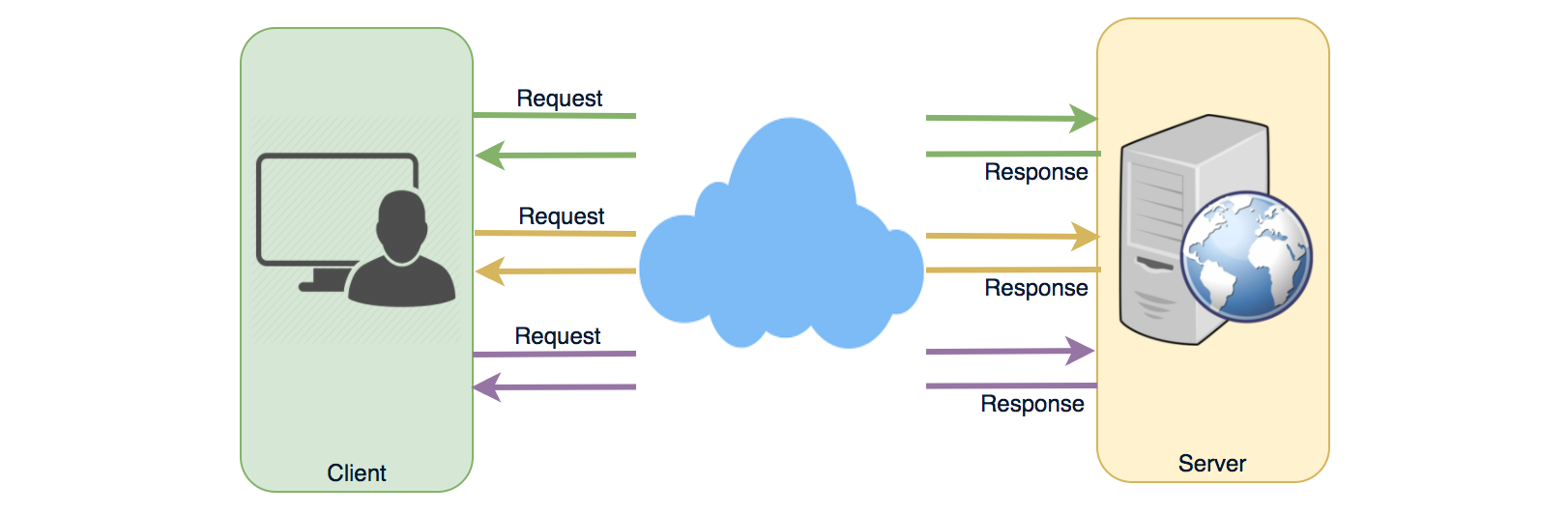
Polling, WebSocket, and Server-Sent Events are popular communication protocols between a client like a web browser and a web server. First, let’s start with understanding what a standard HTTP web request looks like. Following are a sequence of events for regular HTTP request:

  1. The client opens a connection and requests data from the server;
  2. The server calculates the response;
  3. The server sends the response back to the client on the opened request;

Ajax Polling

Polling is a standard technique used by the vast majority of Ajax applications. The basic idea is that the client repeatedly polls (or requests) a server for data. The client makes a request and waits for the server to respond with data. If no data is available, an empty response is returned:

  1. The client opens a connection and requests data from the server using regular HTTP;
  2. The requested webpage sends requests to the server at regular intervals (e.g., 0.5 seconds);
  3. The server calculates the response and sends it back, just like regular HTTP traffic;
  4. The client repeats the above three steps periodically to get updates from the server;

The problem with Polling is that the client has to keep asking the server for any new data. As a result, a lot of responses are empty, creating HTTP overhead.

Read more »

Consistent Hashing

Posted on 2021-02-06

Distributed Hash Table (DHT) is one of the fundamental components used in distributed scalable systems. Hash Tables need a key, a value, and a hash function where hash function maps the key to a location where the value is stored:

index = hash_function(key)

Suppose we are designing a distributed caching system. Given “n” cache servers, an intuitive hash function would be “key % n”. It is simple and commonly used. But it has two major drawbacks:

  1. It is NOT horizontally scalable. Whenever a new cache host is added to the system, all existing mappings are broken. It will be a pain point in maintenance if the caching system contains lots of data. Practically, it becomes difficult to schedule a downtime to update all caching mappings;
  2. It may NOT be load balanced, especially for non-uniformly distributed data. In practice, it can be easily assumed that the data will not be distributed uniformly. For the caching system, it translates into some caches becoming hot and saturated while the others idle and are almost empty;

In such situations, consistent hashing is a good way to improve the caching system.

What is Consistent Hashing?

Consistent hashing is a very useful strategy for distributed caching systems and DHTs. It allows us to distribute data across a cluster in such a way that will minimize reorganization when nodes are added or removed. Hence, the caching system will be easier to scale up or scale down.

In Consistent Hashing, when the hash table is resized (e.g., a new cache host is added to the system), only “k/n” keys need to be remapped where “k” is the total number of keys and “n” is the total number of servers. Recall that in a caching system using the “mod” as the hash function, all keys need to be remapped.

In Consistent Hashing, objects are mapped to the same host if possible. When a host is removed from the system, the objects on that host are shared by other hosts; when a new host is added, it takes its share from a few hosts without touching other’s shares.

Read more »

CAP Theorem

Posted on 2021-02-06

CAP theorem states that it is impossible for a distributed software system to simultaneously provide more than two out of three of the following guarantees (CAP): Consistency, Availability, and Partition tolerance. When we design a distributed system, trading off among CAP is almost the first thing we want to consider. CAP theorem says while designing a distributed system we can pick only two of the following three options:

Read more »

SQL vs. NoSQL

Posted on 2021-02-06

In the world of databases, there are two main types of solutions: SQL and NoSQL (or relational databases and non-relational databases). Both of them differ in the way they were built, the kind of information they store, and the storage method they use.

Relational databases are structured and have predefined schemas like phone books that store phone numbers and addresses. Non-relational databases are unstructured, distributed, and have a dynamic schema like file folders that hold everything from a person’s address and phone number to their Facebook “likes” and online shopping preferences.

SQL

Relational databases store data in rows and columns. Each row contains all the information about one entity and each column contains all the separate data points. Some of the most popular relational databases are MySQL, Oracle, MS SQL Server, SQLite, PostgreSQL, and MariaDB.

NoSQL

Following are the most common types of NoSQL:

  • Key-Value Stores: Data is stored in an array of key-value pairs. The “key” is an attribute name which is linked to a “value”. Well-known key-value stores include Redis, Voldemort, and Dynamo;
  • Document Databases: In these databases, data is stored in documents (instead of rows and columns in a table) and these documents are grouped together in collections. Each document can have an entirely different structure. Document databases include the CouchDB and MongoDB;
  • Wide-Column Databases: Instead of “tables”, in columnar databases we have column families, which are containers for rows. Unlike relational databases, we don’t need to know all the columns up front and each row doesn’t have to have the same number of columns. Columnar databases are best suited for analyzing large datasets - big names include Cassandra and HBase;
  • Graph Databases: These databases are used to store data whose relations are best represented in a graph. Data is saved in graph structures with nodes (entities), properties (information about the entities), and lines (connections between the entities). Examples of graph database include Neo4J and InfiniteGraph;
Read more »
1…192021…55
necusjz

necusjz

271 posts
16 tags
© 2016 - 2026 necusjz
Powered by Hexo
Theme - NexT.Mist